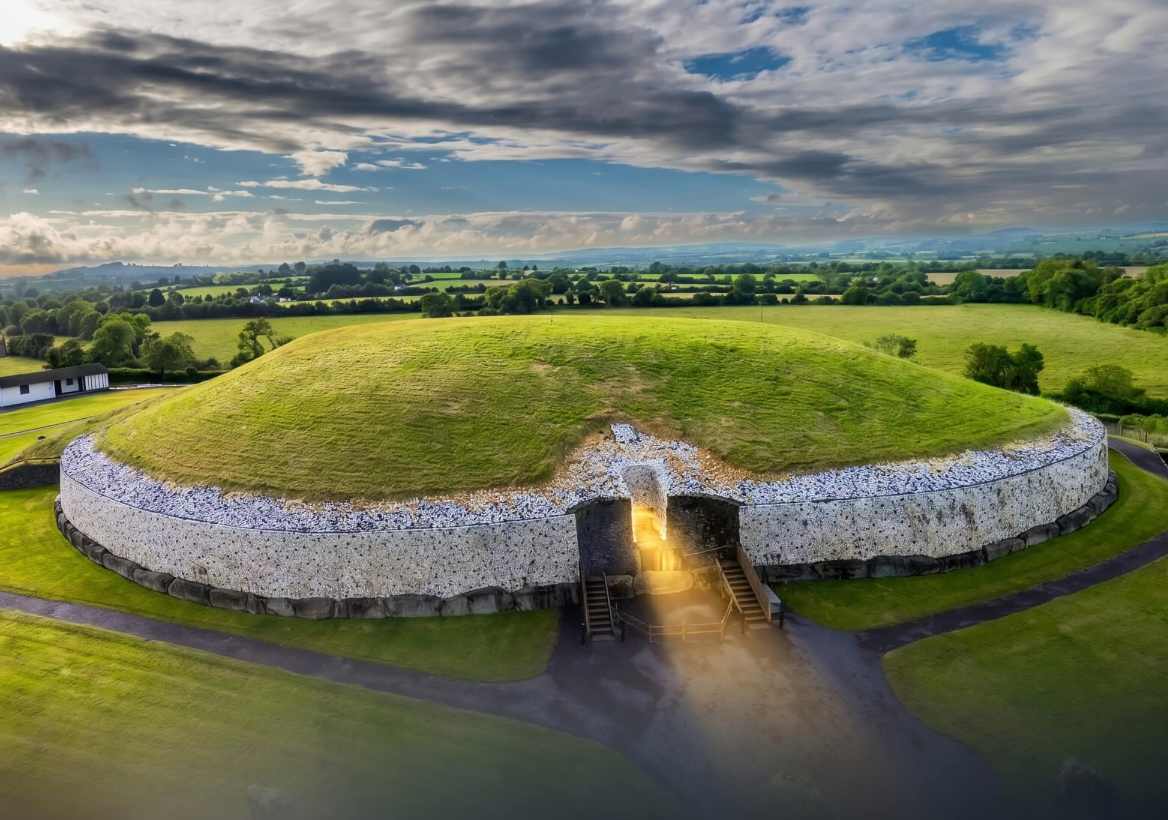
For most of the year, the passage inside Newgrange is almost completely dark. Then, on a few mornings around the winter solstice, just after sunrise, a thin beam of light enters through a small opening above the entrance and slowly reaches deep into the stone chamber at the heart of the mound. The darkness begins to glow gold. For a few minutes, a tomb built more than 5,000 years ago fills with winter sunlight. Newgrange stands in Ireland’s Boyne Valley, north of Dublin, and it is older than Stonehenge and older than the great pyramids of Giza. Built around 3200 BC during the Neolithic period, it is part of a wider ceremonial landscape filled with passage tombs, earthworks, standing stones, and ritual sites. From the outside, Newgrange appears as a great circular mound of earth and stone, edged with white quartz and dark rock. But the real experience begins when you enter the narrow stone passage leading inward toward the burial chamber. The builders carried massive stones to the site, some from many kilometers away. They raised kerbstones carved with spirals, curves, lozenges, and geometric patterns that still survive after millennia of rain and wind. Inside the chamber, archaeologists found cremated human remains, suggesting the site was tied to burial and ritual memory. Yet Newgrange was never only a grave. The architecture itself points toward something larger. The famous “roof box” above the entrance was deliberately designed so the rising winter solstice sun could enter the passage with extraordinary precision. That detail changes how people see the monument. This was not random alignment or lucky accident. Someone understood the movement of the sun across the year closely enough to build stone, angle, and darkness around it. Imagine standing there in midwinter thousands of years ago, after the longest nights of the year, watching sunlight return to the chamber where the dead rested. Was the light meant for ancestors? For rebirth? For the turning of seasons that determined survival itself? The people who built Newgrange lived in a world without electric light, printed calendars, or modern astronomy, yet the sky shaped nearly everything around them. Winter mattered physically. Food stores ran low. Cold settled into the land. The return of longer days carried emotional weight because it meant life continuing again. In that sense, the solstice was not abstract science. It was hope tied directly to survival, farming, animals, and the rhythm of human existence. Newgrange also reminds us that ancient people observed the heavens with patience over generations. Aligning a monument like this required memory, repeated observation, and cooperation. Builders cut stone, moved earth, lit fires, buried the dead, and watched the horizon year after year. Children likely grew old hearing stories about the mound and the morning when sunlight entered the chamber. The monument connected human death with cosmic order in a way that still feels strangely intimate. Today visitors still gather outside Newgrange during the winter solstice hoping to witness the sunrise enter the ancient passage. Most will never see it directly inside the chamber because access is limited, but the idea alone continues to move people. Deep within the mound, beyond the narrow stone corridor, the light still arrives as it did thousands of winters ago: one beam of sunrise touching the darkness where ancient hands once placed their dead.
Amazing World
Public . 28-May-2026Why was a tomb built to catch the winter solstice sun?
0
0
0
Reacts
0
View
21,986
Comment
0