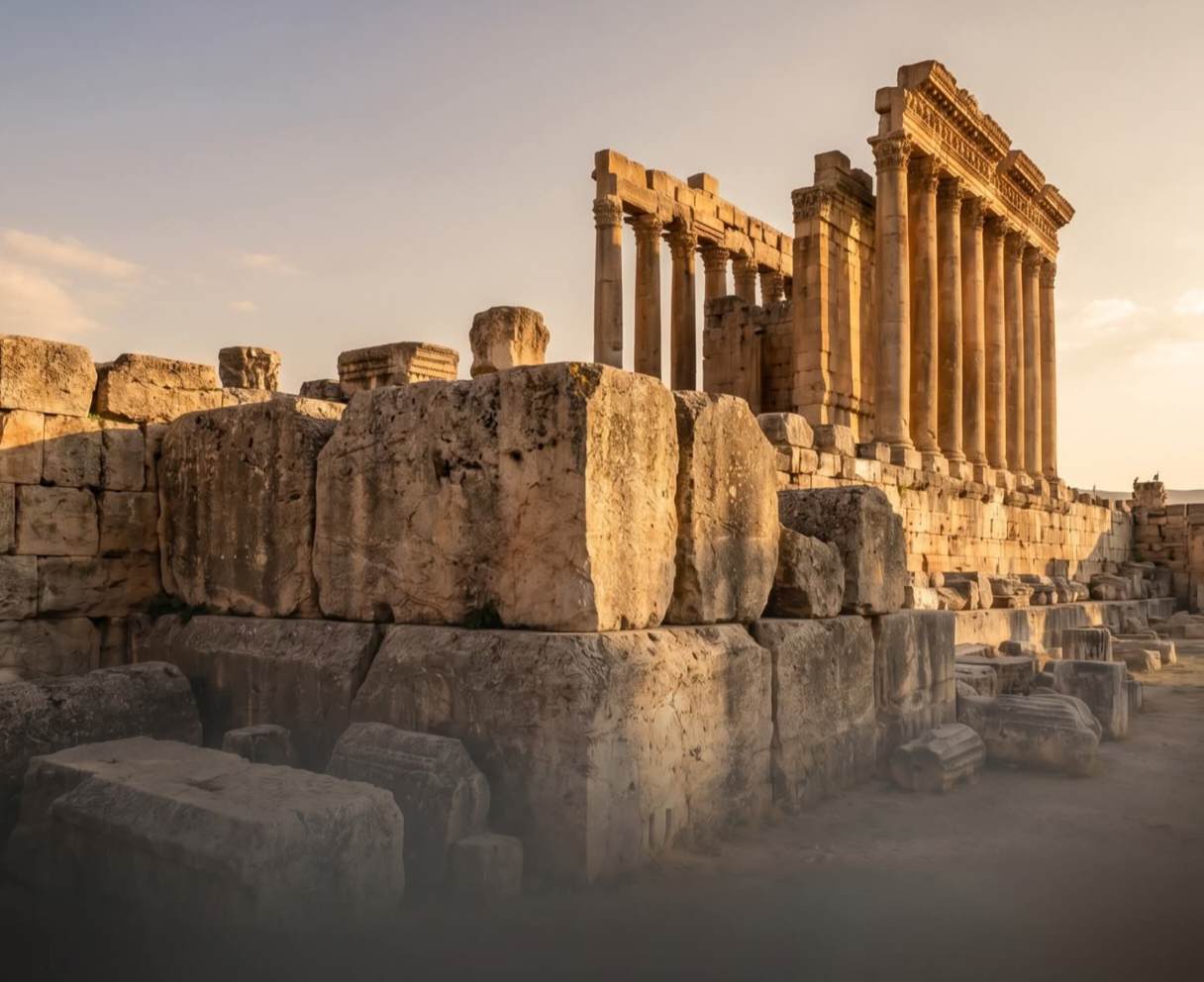
At Baalbek, the largest stones are not standing proudly in the open sky. They sit lower, locked into the base of the great temple platform, as if the mountain itself had been cut into blocks and forced into a wall. Each one is so large that the first reaction is usually silence. Then comes the question people have asked for generations: who moved them? Baalbek stands in Lebanon’s Beqaa Valley, a fertile corridor between the Lebanon and Anti-Lebanon mountains. In the Roman period, the city was known as Heliopolis, and it became one of the empire’s grand religious centers in the eastern Mediterranean. The temples of Jupiter, Bacchus, and Venus rose there in stone, column, carving, stairway, courtyard, and shadow. Rome did not choose small gestures when it wanted to be remembered. The most famous stones are the great megaliths in the podium of the Temple of Jupiter. Three enormous blocks, often called the Trilithon, were placed into the platform wall. Each weighs hundreds of tons. Nearby quarries contain even larger stones, including the famous “Stone of the Pregnant Woman,” left partly cut in the ground. These unfinished blocks matter because they show the work was not legend. Men marked stone, cut channels, shaped edges, and prepared the impossible-looking pieces before transport ever began. The honest answer is that we do not know every detail of how Baalbek’s largest stones were moved and set. Roman engineers could do extraordinary things with roads, ramps, capstans, pulleys, sledges, rollers, earthworks, timber frames, and organized labor. But the scale here remains severe. Moving such blocks would have required planning, terrain control, many workers, and a command system able to feed, direct, and pressure human bodies through dangerous work. How many hands held ropes? How many overseers shouted orders across dust and stone? How many workers watched a block shift by inches after a day of effort? There is also the older question beneath the Roman one. Baalbek was not invented from nothing when Rome arrived. The site had earlier sacred importance, and scholars have long discussed how much of the great platform may have drawn on earlier local traditions or foundations. The Roman temple complex certainly reshaped the place on a vast imperial scale, but the deeper memory of the site likely reached further back into the religious landscape of the region. That is part of Baalbek’s power: it feels Roman, local, older, and imperial all at once. The size of the stones was not only a technical choice. It was a message. A temple platform made from ordinary blocks can hold columns. A platform made from stones weighing hundreds of tons says something else. It says the ruler, the god, the city, and the empire stand above normal limits. It turns engineering into theater. Anyone walking toward the sanctuary would have understood the lesson before a priest spoke a word. Baalbek does not need fantasy to be remarkable. Its mystery is human enough. Somewhere in that valley, men cut giant stones from living bedrock, dragged them toward a sacred platform, and raised a monument where power became architecture. The question is not whether they could do it. The stones are still there, resting beneath the temple like a challenge in limestone.

Amazing World
Public . 29-May-2026Who moved the giant stones beneath the Roman temple?
0
0
0
Reacts
0
View
21,561
Comment
0