The Romans make Olive Oil

The Romans make Olive Oil

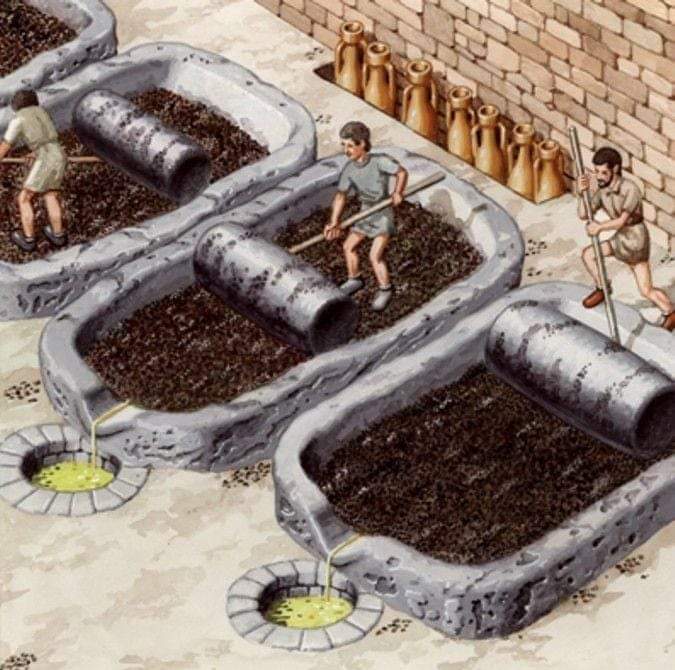
Romans helped make Olive Oil what it is today, improving the techniques for cultivation and transportation. They consumed olives and Olive Oil from the Baetica region of Hispania (modern-day Andalusia) on a large scale. In fact, the oil from Hispania was the Empire’s most valued for its high quality. It is estimated that during this period Hispania exported more than 30 million vessels of Olive Oil, with thousands of them being sent to the Empire’s capital, Rome. The remains of many of the vessels that transported the oil were unearthed at the end of the 19th Century CE, when Heinrich Dressel, an Italian-Prussian scientist, discovered them buried in a Roman hill. Investigating their origins, he discovered that residents from that time used to discard the empty vessels from Baetica on the left banks of the River Tiber. The fragments, along with the soil that accumulated over time, came to form a hill that is known today as Testaccio. In the Middle Ages, Olive Oil was often used to make soaps in Spain and in neighbouring France. Not surprisingly, it has had many uses such as fuel to light homes or as an ingredient in beauty treatments. But its main use has been, and continues to be, for food. Olive Oil, whether it is Extra Virgin, Virgin, or simply Olive Oil, is perfect in any recipe. Later, in the 19th Century CE, the cultivation of Olive Oil expanded in Spain owing to the construction of the railway network. It was thanks to this new mode of transport that the country became the largest olive grove in the world. In 20th Century CE, a technological revolution in Spain allowed for the production of even higher quality oils, ones that win, year after year, at the world’s most prestigious competitions. Nowadays, Spain is the world leader in quantity and, above all, quality when it comes to Olive Oil.
View 103,097 | Like () | Comments (0)
Profile Photo

Unearthed right near the iconic Great Pyramid of Giza

Unearthed right near the iconic Great Pyramid of Giza

Prepare to be blown away by this jaw-dropping discovery! An ancient priest's tomb has been unearthed right near the iconic...Read more

View 105,866 | Like () | Comments (0)

Fingals Cave in Scotland

Fingals Cave in Scotland

The dramatic and iconic island of Staffa - just ½ mile long and ¼ mile wide - off the west...Read more

View 53,876 | Like () | Comments (0)

Sacred Valley, Peru

Sacred Valley, Peru

High in Peru’s Sacred Valley, the Ancasmarca ruins reveal the incredible resourcefulness of the Inca Empire. Built into steep mountain...Read more

View 37,619 | Like () | Comments (0)

Rocchetta Mattei, Italy

Rocchetta Mattei, Italy

Rocchetta Mattei is a castle located on the Northern Apennine Mountains. It blends various eclectic styles, from medieval to moorish....Read more

View 108,804 | Like () | Comments (0)

The Kastelburg Germany ??

The Kastelburg Germany ??

The Kastelburg is a ruined castle above Waldkirch in the district Emmendingen in Baden-Württemberg. The Kastel castle was built between 1260...Read more

View 103,632 | Like () | Comments (0)

The Eketorps borg Sweden ??

The Eketorps borg Sweden ??

Eketorp is an Iron Age fort, located in southeastern Öland, Sweden, and extensively reconstructed and enlarged in the Middle Ages....Read more

View 105,679 | Like () | Comments (0)

The Castel Nuovo Italy ??

The  Castel Nuovo Italy ??

Castel Nuovo (Italian: [kaˈstɛl ˈnwɔːvo]; "New Castle"), often called Maschio Angioino (Italian: [ˈmaskjo andʒoˈiːno]; "Angevin Keep"), is a medieval castle...Read more

View 105,789 | Like () | Comments (0)

The Kőröshegy Viaduct stands

The Kőröshegy Viaduct stands

The Kőröshegy Viaduct stands as an awe-inspiring fusion of modern engineering and the untouched beauty of nature. As Hungary’s longest bridge,...Read more

View 94,403 | Like () | Comments (0)

The Brazilian Pau tree or Paubrasilia echinata.

The Brazilian Pau tree or Paubrasilia echinata.

The Brazilian Pau tree, or Paubrasilia echinata, is a special tree from Brazil’s Atlantic Forest. It is a national symbol...Read more

View 97,617 | Like () | Comments (0)

The Schloss Heidelberg Germany

The Schloss Heidelberg Germany

Heidelberg Castle (German: Heidelberger Schloss) is a ruin in Germany and landmark of Heidelberg. The castle ruins are among the...Read more

View 108,164 | Like () | Comments (0)